
The Practice Playbook
A proven system that builds a team to run your practice, so you can lead and do the dentistry you love.
A done-with-you programme. We work together to install the systems in your practice, one step at a time. By the end, your team knows what to do, does it without being asked, and keeps your standards high.
25 minutes, no pressure. We'll look at where your practice is now and where it could be.
Sound familiar?
The practice runs on you.
Every question comes to you
You're in surgery all day and you're still the person everyone waits for, so the day ends with a queue of decisions nobody else felt able to make.
Good people leave, and you're recruiting again
You hire well, and eight months later you're writing the same advert, because the new person walked into the same unclear set-up the last one did.
Things get agreed, then nothing changes
The team day was good and the meeting went well, and a fortnight later everything is back to how it was.
It's quicker if you just do it yourself
So you do. You hand a job over, it comes back not quite right, and before long it's back on your desk for good.
None of that means you've got the wrong team, and it isn't because you're not working hard enough. It's how the practice has been set up, and that can be changed.
What changes for you
What's different twelve months from now
The message about nursing cover goes to your practice manager, gets sorted, and you hear about it afterwards. That's what this looks like when it's working, and it's the bit you'll notice first.
- Your time comes back.The hours you used to spend fielding questions are hours in surgery, which is the only kind of time management that ever shows up in the accounts.
- Your numbers have moved, and you can show it.Chair utilisation, income per surgery per day and the handful of numbers your team chose are taken on day one and every quarter after, so you can see what's moved rather than hope it has.
- Your team knows what the practice is for.Anyone can tell a patient in their own words, and when you're choosing between a scanner and a third hygienist, there's something to decide it against other than how you feel that week.
- New people land well and stay.A new nurse's first fortnight is planned before she starts, and the nurse who would have gone at eight months is still there.
- Problems get said early.The thing that would have become a grievance gets said in the room, by the person it belongs to, while it costs an awkward ten minutes rather than a locum, a solicitor and six months of atmosphere.
- Standards hold without you.A standard that slips gets picked up that week, by someone who isn't you, without it becoming a whole thing.
And a practice that holds its standards with you out of the building is the practice that's worth something when you come to sell it.
Take a fortnight off, tell nobody to hold the fort, and look at what's waiting when you get back. If the standards held, they're installed. If what's waiting is a fortnight of decisions nobody felt able to make, they were never standards, they were you.
Twelve months from now
It's a Tuesday morning, and you're not in the building.
A standard slipped last week, and someone who isn't you picked it up that same day. The diary is full, the rota got sorted between them, and nobody needed to ring you.
You could be anywhere in the world, and the team takes full responsibility, because the practice runs on systems and the people who own them, not on you.
Book your discovery callProof, led by renewal
What changes when the systems go in
Amy now has Mondays and Fridays off. The management team sorts things out in the group chat, and she doesn't come back in on a Tuesday to a list.
team members say "team first" is now just how things are, and 13 of 15 say the same about handovers.
Georgia's two end-of-day reports to the owners have gone for good. Debts, accounts and CPD logs have moved to the team, and none of it has come back to her.
in business, and the owners feel on top of it for the first time. The department leads now run the day, so the practice runs because it runs, not because they're holding it up.
including a new lead nurse, with three hygienists interested and a good nurse turned away. "I used to end up lowering my standards because that was what was available."
patients on the waiting list, worked through and closed, and the weekly takings target is now being beaten after months of missing it.
More than 80% of the practices I work with renew, and nobody renews to be polite.
A kind quote costs the person giving it a few minutes. A renewal costs money, which is why it's the part I'd look at if I were you. None of them turned things round in a weekend. They did the unglamorous version, one thing at a time, bedded in before the next one started.
"Mark has an exceptional ability to take complex, often overwhelming topics and break them down into simple, practical steps."Dr Pat Langley, Clinical Director, FMC
"Mark is a clear thinker, a calm leader, and a brilliant communicator."Chris Barrow, Author, Speaker & Business Coach
There's no finished cohort of this programme to point at yet, because the first one starts in January 2027. What there is instead is twenty-five years of doing this work one practice at a time, and the practices above.
In good company
Practices and organisations I've worked with

















And the organisations I work with












Judging panels



Find me in






How it works
How it works
Two sessions a month for twelve months, with you and your practice manager both in the room. One session to build a system, the next to bed it in, and when it stutters in week three, which it will, that's what the next session is for.
You don't write the system. You haven't got the evenings to invent an induction process from scratch, and you shouldn't have to. You get the system, and building it into your practice is what we do together.
And your team hears it first. Before anything changes, they hear what's coming and why, with short pieces of their own that build month by month, so nobody walks in on a Monday to a new system they've never heard of.
Each month installs one thing and moves one number. Before month one you and your practice manager take your numbers with me, things like chair utilisation and income per surgery per day, and they're taken again every three months, so what has changed is on a page, not in a feeling.
Your team gets three to five numbers of its own, ones it can move and see move, like new patients, conversions or chair utilisation. The practice's overall performance comes into the room. Individual clinicians' numbers never do.
There are six systems, and they go in in order, starting with you and your numbers:
- Get Steady, Get Clear
Months one and two - Create Culture by Design
Month three - Say It Straight, Say It Kindly
Month four - Get It Off Your Plate
Month five - Hold the Line
Month six - Hire for Fit, Land Them Well
Whenever you hire
Hiring sits outside the calendar because vacancies don't wait: there's support from month one whenever you hire, and the whole room works through it together in month eight, once you know what fit means here.
Months seven to twelve: then the team comes in
By month six the systems are built and you and your practice manager are holding them. The second half of the year makes them the team's, not yours.
Think of a young tree. You cut back what isn't working, feed what is, and give it time to strengthen.
- Your fortnightly sessions carry onThe six-month numbers taken again, what to stop, the next gap to close, Hire for Fit for the whole room, and growing the leads who'll run it after you.
- A session a month for one part of your teamReception one month, nurses another, so each part of the team gets a session of its own on its part of what's been built and the numbers it can move.
- Team pieces on demandShort, interactive, and marked as they go, so you can see who's taken part without chasing.
- Month twelveYour numbers taken a final time, and your year on one page.
Every session is recorded, and you'll have it the same day.
It runs in a small group: small enough that I see what's actually happening in your practice, big enough that you're not the only one solving it. The next group starts in January 2027.
Where AI fits
Built with AI, bedded in by people.
I'm a big fan of AI. I use it with every practice I work with to build policies, trackers, rotas and meeting agendas in a fraction of the time it used to take. If you're learning to do that yourself, brilliant, you should. It's one of the best things to happen to practice management in years.
And then Monday morning arrives. The policy is sitting in a shared folder, reception are still answering the phone the old way, and the tracker got filled in twice and then forgotten. That's not because anyone's lazy. A system doesn't change behaviour on its own. People do that, with some support, over weeks rather than an afternoon.
That's what the Playbook is for. AI builds the system, and we make it the way your team works.
One practice I work with already had a good task list that nobody looked at. The list didn't change. The weekly rhythm around it did, and now it runs on a busy day without anyone chasing.
Your first 90 days
What could you expect in the first 90 days?
Every practice starts somewhere slightly different, but for most, the first ninety days look like this.
You're steadier and calmer
Your week has some shape to it again, and you know the three or four numbers that tell you how the practice is really doing.
Everyone knows who owns what
The top roles are written down and agreed, so the questions that used to come to you have somewhere else to go.
Your first gap is closed
The one thing that takes the most off your plate gets built and bedded in before anything else starts.
Who it's for
Who it's for
It's right for you if the practice runs on you and you've had enough of that. Some people come to this having read everything and been on every course going. Others got where they are by being good at the job and saying yes, with no time for any of that. Both work. What's missing is a system that holds when you aren't holding it.
It's not for you if what you want is more content. You've almost certainly got more than you can use already, sitting in a folder somewhere.
And it's not for you if you can't commit to two sessions a month with your practice manager beside you. One of you attending and reporting back is the thing we know fails, which is why both seats are non-negotiable.
Consistency beats intensity. Every time.
My promise
My promise to you
If I don't think the Playbook will make a real difference to your practice, I'll tell you on the call, and point you somewhere better if I can.
If you join and it isn't right for you, tell me in the first two weeks and you get your money back, as long as you've come to the onboarding and the sessions.
Mark Topley, Team Performance Specialist
I do one thing.
I help dental practices build teams that run the practice, and I teach the people at the top how to lead them.
If you want help with marketing or your fees, I'll point you to someone brilliant. If it's your team and how you lead it, that's me, and teaching it properly is what I'm qualified to do.
I qualified as a teacher before I ever set foot in a dental practice, and it's the reason any of this sticks. Most training in dentistry is built by people who are very good at the subject and were never taught how anyone learns, which is why so much of it is interesting on the day and gone by Friday.
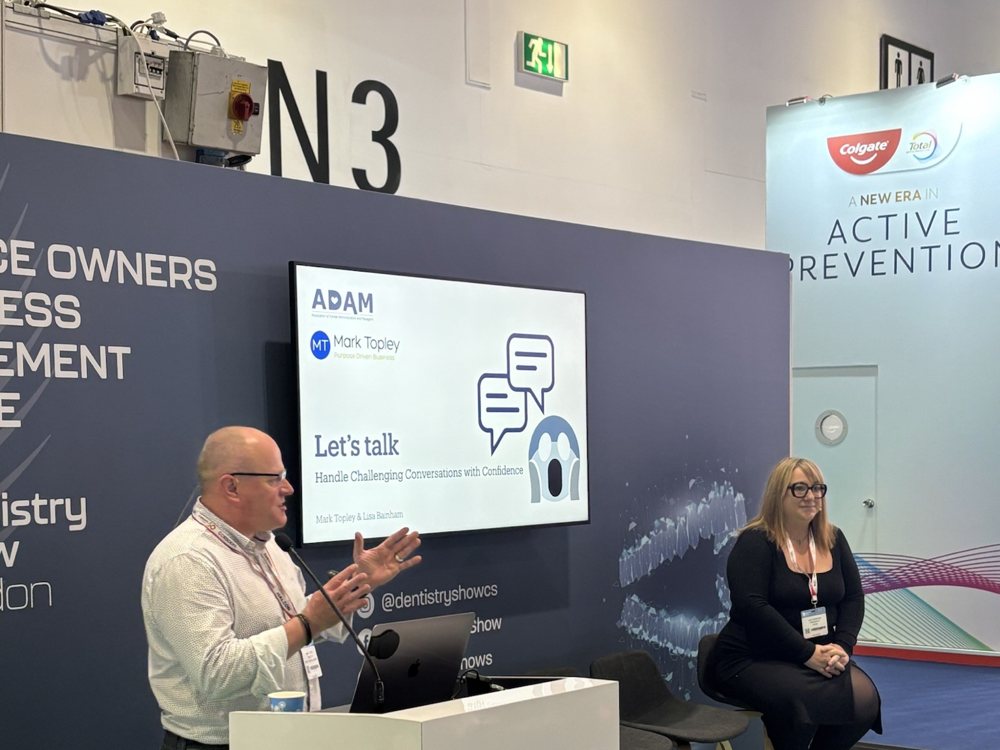
I spent thirteen years running Bridge2Aid in Tanzania, which is where I learned most of what I know about leading people who don't have to do what you say. Today I write for Dentistry and Private Dentistry and speak at the BDA and the Dentistry Show.
I also burned out once, properly, which is why every decision in this programme gets judged on one question: does this take load off you, or pile it on?
FAQ
The questions people actually ask
What happens on the call?
25 minutes, you and me. We look at where the practice is now, where you want it to be, and whether this is the right way to get there. If it isn't, I'll tell you that too.
What if my practice manager leaves halfway through?
Then we recruit and onboard the next one together, and that's in the programme already, not an extra. It's also where you find out whether the work stuck: if what you built is installed, it survives the handover.
What happens if we miss a session?
Every session is recorded and you'll have it the same day, so a missed one costs you the conversation rather than the content. There's a spare week in every month for rescheduling. What doesn't work is missing them quietly and repeatedly, and I'll ask about it.
Will my team see the practice's figures?
Some of them, and only the ones that help. Your team works with three to five numbers it can directly move, like new patients or chair utilisation, and the practice's overall performance comes into the room. Individual clinicians' numbers never do. You and your practice manager get comfortable with the numbers first, months before the team is brought in properly.
We're mid-refurb, mid-associate change or mid-CQC. Should we wait?
Usually no, because there isn't a quiet year coming, and waiting for the clear run is how three years go past. The one case where I'd say wait is if you're selling, merging, or unsure you'll still own the practice in twelve months. Tell me on the call and I'll say so straight.
What if it doesn't work?
You can change your mind in the first two weeks and get your money back, as long as you've attended the calls and taken full part in the onboarding. After that, turn up and run the projects, and if it isn't installed by the end of the twelve months we keep going until it is, at no extra cost.
Can't I just use AI to build this myself?
You can, and I'd encourage it. Building the system is the quick bit now. The Playbook is about the slow bit: getting your team doing it week in, week out, until it's simply how things are done.
What does it cost?
£11,964 for the twelve months including VAT, committed six months at a time and invoiced to the practice monthly, with no finance company. You're not buying my hours, though. Twelve months from now the question won't be how many sessions there were, it'll be whether the practice runs without you and is worth more because it does, and a cheaper year that changes nothing is the expensive option.
Start with a conversation
25 minutes to look at where your practice is now and where it could be in twelve months. If it's a fit, we'll talk about what comes next. If it isn't, I'll tell you that too.