THE PRACTICE PLAYBOOK
Every autumn brings the same creeping dread: a swollen to-do list, clinical bottlenecks, and a team relying on your personal energy to solve every operational hiccup. The 12-month Playbook installs six self-governing systems that liberate your schedule, protect your margins, and run your clinic reliably in your absence.

One nurse is off sick and the message asking for cover has come to you rather than to your practice manager. Two patients complained about the same thing last week and nobody has decided what to do about it. The associate wants a word and won't say what it's about. And on the shelf behind you is the folder from the course you paid for the year before last, with the notes you took, which were good notes.
Nothing in that folder is wrong. You've read the books and been on the courses and taught some of it to your own team, and you could describe a well-run practice better than most consultants can. And still, by ten o'clock, all four of those things have come through you.
That's the gap. Not the gap between what you know and what you believe, but the gap between what you know and what happens in the building when you aren't standing in it.
The reason none of it stuck isn't that you didn't try hard enough. Nothing was ever installed, so it was always going to run on your attention, and your attention was always going to run out.
You are the system. That works, right up until it becomes the thing holding the practice at the size it's at, which it usually is by the time there are more than a dozen people in the building.
The hard truth: Your practice does not have an inspiration deficit. It has an installation problem. Implementation is a systems problem, not a discipline problem.
After observing hundreds of leadership teams, these four structural truths have ceased to be debates. They are the non-negotiable laws of practice scale.
Twenty-five years in dental and I've never met an owner who needed the answer explaining to them.
They could all tell me what they should be doing, usually in more detail than I'd have given. What they didn't have was a way of making it happen in a week when three things went wrong, and three things always go wrong.
Most of what gets called a people problem isn't one. The nurse who "doesn't take ownership" was never told what she owns. The receptionist who "can't say no" was never given the authority to.
Get clear on who owns what, who decides, and what good looks like, and most of those problems quietly stop. Skip it, and you'll keep replacing people and getting the same problem back with a new name on it.
Here's the test, and you can run it without buying anything from me. Take a fortnight off, tell nobody to hold the fort, and look at what's waiting when you get back. If the standards held, they're installed.
If what's waiting is a fortnight of decisions nobody felt able to make, then they were never standards, they were you.
Most practices I walk into have four improvement projects on the go. New induction, new appraisal system, something about the morning huddle, and a values exercise from a training day in the spring.
Ask when one of them was last finished and the room goes quiet. Not because anyone was lazy, but because four at once is how you get none.
That's why in the Practice Playbook there are six systems over twelve months rather than thirty over six, and why everything in the programme gets judged on one question: does this take load off you, or pile it on?
The order isn't a preference. You can't hand real authority to a team you haven't got pointing the same way, and you can't recruit for fit until you know what fit means here, so each one holds up the one after it. You start with yourself and work outwards.
steady yourself first, then point the whole team the same way.
any member of your team can tell a patient what this practice is for, in their own words, without looking it up. And when you're deciding between a scanner and a third hygienist, there's something to decide it against other than how you feel that week.
culture happens by default unless you build it on purpose, and it shows up in daily behaviour, not on a wall or a document.
someone new works out within a fortnight what gets rewarded here and what doesn't, from what actually happens rather than from what they were told on day one. The nurse who would have gone at eight months stays, and you don't pay to recruit and train her replacement.
recruit for who they'll be in two years. Induct for the long term.
you stop hiring the first person who applies because you're desperate, and a new nurse's first fortnight is planned before she starts rather than at half eight on her first morning. A hire that doesn't work costs you twice, once to make it and once to unpick it, and that's before the surgery you couldn't run while you looked.
clarity is kindness. Early is kinder still.
the thing that would have turned into a grievance in March gets said in the room in January, by the person it belongs to. Problems get dealt with while they still cost an awkward ten minutes rather than a locum, a solicitor and six months of atmosphere.
delegate authority, not tasks.
the Monday morning message about nursing cover goes to your practice manager, or your lead nurse, gets sorted, and you hear about it afterwards. The hours that come back are hours you can spend in surgery, which is the only kind of time management that ever shows up in the accounts.
challenge high, support higher.
a standard that slips gets picked up that week, by someone who isn't you, without it becoming a whole thing. And a practice that holds its standards with the owner out of the building is the practice that's worth something when you come to sell it.
None of that is aspiration. Every line above is a behaviour you could watch happen on a normal Wednesday afternoon,
which is the only test worth applying to any of this. Where knowing meets doing, and doing creates results.
The Exceptional Team System is the six systems. The Practice Playbook is how they get installed.
You went on the course. Your practice manager didn't.
So you came back with three pages of notes and a plan they weren't in the room for, and you explained it well on the Tuesday, because you're good at explaining things. But it arrived as something you'd decided somewhere else and were now asking them to run, which is a different animal from something the two of you built. By the third week it's back on your list.
It works the same way round the other way. Your practice manager does the qualification, comes back full of what they'd change, and nothing about how decisions get made here has moved an inch while they were away. Six weeks later they've stopped bringing you ideas, which is the expensive part.
Business coaching sits over here for owners and training sits over there for managers. It's all perfectly good, and it's all aimed at one person at a time.
Some programmes do get you both in the room, a few days a year, and then you go home and try to action the plan on your own using the same diary that stopped you last time.
In the Practice Playbook, it's twenty-four sessions across twelve months, two a month, one to build and one to bed it in. We don't hand over theory and leave you to it. You don't write the system either — you haven't got the evenings to invent an induction process that works on the people actually coming into dentistry now. You get the system, and building it into your practice is what we do together. When it stutters in week three, which it will, that's what the next session is for.
Both of you, every session, twelve months, one price.
You can't install anything from one half of the practice, and nothing gets installed a few days a year.
I qualified as a teacher before I ever set foot in a dental practice.
That was thirty years ago, and it's simultaneously the least interesting thing about me and the reason any of this sticks. Most training and development in dentistry is built by people who are very good at the subject and were never taught how a person actually learns anything, which is why so much of it is interesting on the day and completely gone by Friday.
That's the bit I'm setting out to change. Teaching and change management are crafts with their own rules, and I spent four years learning them and the thirty years since putting them into practice.
Edmondson on how teams speak up, Gallup on why people stay, the work on trust and on how change actually beds in. Not a reading list, and not theory for its own sake — only the parts that survived twenty-five years of me trying them in real practices, built into the six systems. It's also what decides the shape of the year.
Every one of the six systems has been through real practices, which is a harder test than it sounds. The question was never whether it made sense in a workshop. It was whether it was still running six months later, in a busy week, with nobody chasing it.
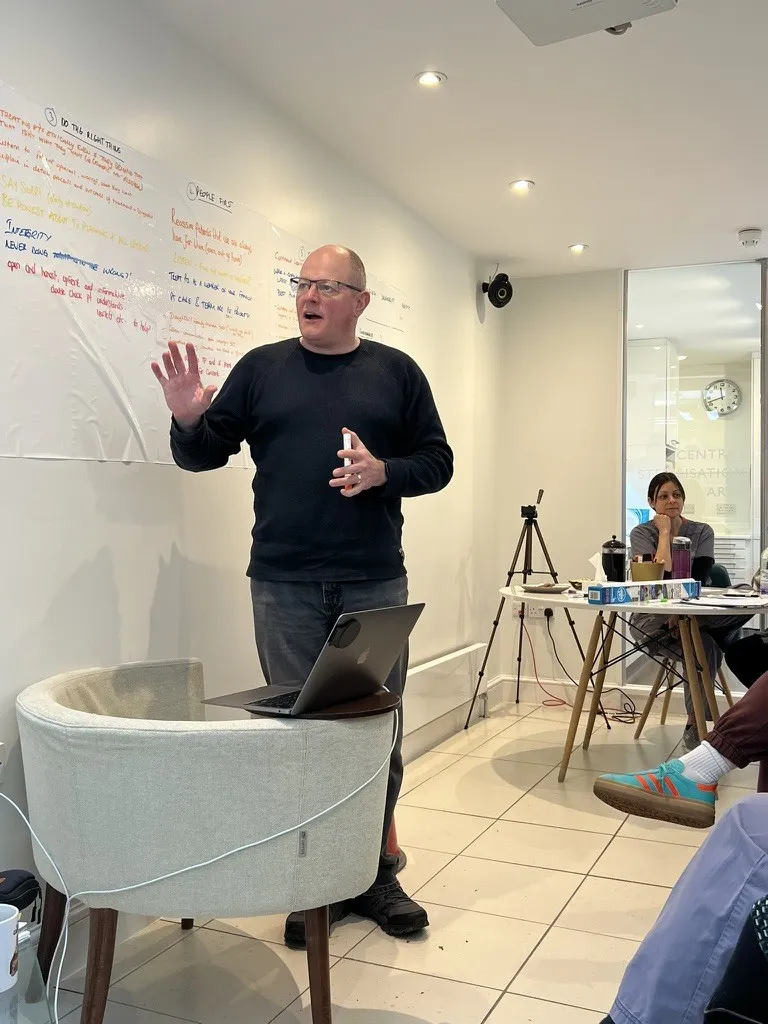
Each system gets built in one session and bedded in at the next, with both of you in the room, because that's how people actually learn something well enough to keep doing it. It's the teacher part, and it's the part most training in dentistry leaves out.
Testimonials are the cheapest thing on any website, this one included. A kind quote costs the person giving it a few minutes and nothing else, which is why every page in this market has a row of them and why none of them tell you very much. A renewal costs money, and nobody renews to be polite. That's the part I'd look at if I were you.
Seven practices have renewed with me, and every one of them was working through these same six systems. Three started in 2025 and have each renewed twice since. Two more started in 2025 and have just signed on for a second year. One started in January 2026 and is contracted through to August 2027, and another is contracted into 2027 as well. Four of those signed in the last few weeks.
Every one of them had already had what they paid for. Not one turned things round in a weekend — they all did the unglamorous version, one thing at a time, bedded in before the next one started, and none of them looks anything like it did when we started.
Here's what I haven't got, and I'd rather say it than have you notice it. There's no finished cohort of this programme to point at, because the first one starts in January 2027. What there is instead is twenty-five years of doing this work one practice at a time, the seven above, a room capped at ten so I can see whether it's working for you before you've decided it isn't, and two weeks at the start to change your mind and get every penny back with no conversation needed.
"Mark has an exceptional ability to take complex, often overwhelming topics and break them down into simple, practical steps. He communicates with clarity, warmth, and insight, making big ideas accessible and actionable for every member of the team."
"Mark is a clear thinker, a calm leader, and a brilliant communicator. He leads by example, listens deeply, and inspires the people around him to grow and succeed."
What you want is more content. You've almost certainly got more than you can use already, sitting in a folder somewhere, and another library isn't the thing that's missing.
You can't commit to two sessions a month with your practice manager beside you. That isn't a scheduling preference, it's the evidence-based programme design. One session to build, one to bed it in, and if only one of you is ever in the room, what gets built doesn't survive contact with a Monday morning.
The practice runs on you and you've had enough of that. Some people come to this having read everything and been on every course going. Others come having had no time for any of that, and got where they are by being good at the job and saying yes. Both work.
What you already know isn't the qualifying bit, and neither is how capable you feel about it on a bad week.
What's missing is a system that holds when you aren't holding it. That isn't a discipline problem. It's a systems problem, and it's the only problem this is built to solve.
Take the Implementation Gap scorecard. Ten questions, three minutes, and it tells you which of the six is currently running on you rather than running on its own. Result on screen, a fuller read by email within the hour, and I read every one myself.
Find out which of the six is running on you →Well-led on an ordinary Tuesday: what inspection sees that the paperwork can't hide. Seven o'clock, Tuesday 20 October, live, with Dr Pat Langley, hosted by FMC on dentistry.co.uk. An hour with questions after it, and an hour of enhanced CPD towards development outcome B. You'll leave knowing what well-led looks like on a normal working day, and how to make compliance a whole-team habit rather than one person's job, and that's yours whether or not you ever speak to me again.
Register free →Applications for the founding cohort are open until 23:59 on Friday 23 October, and the first cohort starts in January 2027. Ten places, never more than fifteen. That's per cohort, and there's a new one every six months — this one starts in January, the next in July. What doesn't change is the size of the room.
£11,964 for the twelve months, including VAT, committed six months at a time. £5,982 covers the first six, and the second six is a renewal rather than a discount.
You pay £997 today, and that isn't a booking fee, it's month one, January. The rest runs monthly from February, spread at 0%, with no finance company involved and no premium for paying that way.
You're not buying twenty-four hours of my time. You're buying a practice that runs without you, holds its standards when you're not in the building, and is worth more because it does. Judge the price against that rather than against the size of the diary entry.
Both of you at every session, and the cohort day in London at month six, late June or early July 2027, is in the price.
Two weeks at the start to change your mind, a full refund, no conditions and no conversation needed. After that, turn up and run the projects, and if it isn't installed by the end of month six we keep going until it is, at no extra cost.
Apply for the January cohort →
Nine modules of the underlying material, run with Practice Plan. It teaches it rather than installs it, and it's where a lot of people start. The Playbook is where they go next.
Conferences, group meetings, and in-practice days with a whole team in the room.
The podcast, back with season five in January.
A monthly column in Dentistry, pieces in Private Dentistry, and a book in progress called The Exceptional Dental Team.
I've been in and around dentistry for twenty-five years. Thirteen of them I spent running Bridge2Aid in Tanzania, organising programmes for teams of clinicians to train rural health workers to take teeth out safely. It’s where I learned most of what I know about leading people who don't have to do what you say. Before any of it, I qualified as a teacher, which is the part that shapes how all of this is built.
I live in Hampshire, I write for Dentistry and Private Dentistry, I speak at the BDA, the Dentistry Show and elsewhere, and I've judged the Private Dentistry and Dental Industry Awards for years. I also burned out once, properly, which is why every single decision in this programme gets judged on one question: does this take load off you, or pile it on?
What I'm actually trying to change is bigger than one practice at a time. Dentistry is organised around a hierarchy that stopped making sense years ago, and almost nobody in it was ever taught to lead, or implement change — not at dental school, not on the way to owning the place. Then we call the results a people problem. It's a structural problem and a teaching problem, both of them fixable, and that's the only reason it holds my attention.
And none of this is peculiar to dentistry. Any profession that promotes on technical skill ends up in the same arrangement — the best practitioner at the top, running something nobody ever trained them to run. Vets, lawyers, GPs, architects, engineering partnerships: same structure, same assumption that being excellent at the work and being able to lead the work are the same muscle. Dentistry is where I know the detail well enough to prove it, and it's a good place to prove it, because a practice is small enough to see all of at once and it fails visibly when the structure is wrong. Practices first, then how the profession teaches this, and then a long way past dentistry.
"When you fix the system, you stop fixing people. A structured practice gives clinicians back their passion and teams their dignity."
— Mark Topley
A short thing most Mondays that takes about a minute to read. No pitch, and you can leave whenever you like.
Get One Minute Monday →
MENU
SERVICES/ RESOURCES
CONTACT

Leadership and culture for dental practices, built so the standards hold when you're not in the building.